Own the runtime
One Rust binary. Config and keys in ~/.oscar, sessions in SQLite,
skills as plain files. Nothing depends on an Oscar account.

One Rust binary runs sandboxed tools and saves sessions on your machine. Extend it with Lua. Model requests go to the provider you choose.
Example session: you ask Oscar to run the tests and check the README. Oscar reads README.md, asks for approval before running cargo test, you allow it once, and Oscar reports that the tests pass and the README matches the CLI flags.
The installer fetches the latest Linux build, verifies its SHA-256, and places oscar in ~/.local/bin. No account, no package manager.
curl -fsSL https://oscar-agent.com/install.sh | shLinux x86_64 today; aarch64 is planned. To pin a release, set OSCAR_VERSION.
Not a chat tab. Not a hosted assistant. A runtime you install, inspect, configure, and, if you ever disagree with its direction, fork.
One Rust binary. Config and keys in ~/.oscar, sessions in SQLite,
skills as plain files. Nothing depends on an Oscar account.
The loop, tools, approvals and matrix gateway are Rust. Your tools are Lua 5.4 in a sandboxed VM, small enough to read before you run it.
no Python or Node at runtimeHost mode works on your machine like you would, behind an approval gate, an audit
log and a guarded Oscar home. Workspace mode puts every command in a user-namespace
jail with no network and a read-only .git.
OpenCode Go and OpenRouter are first-class; OpenAI-compatible endpoints and Anthropic are there when configured. Oscar has no default provider to silently bill.
bring your own key · no assumed vendorOscar joins a room as itself: E2EE, reaction approvals, room commands, a delivery ledger that survives restarts, and one message at a time.
olm · e2ee · reaction approvalsSkills, memory and the curator live in your home directory. After your turns a background review keeps memory current and proposes skills; you accept them, it never silently rewrites one. Hindsight can add long-term memory.
SKILL.md · MEMORY.md · proposals · HindsightOscar's full-screen TUI shows the model, the workspace, the approval mode and the boundary before you type. Tool calls become compact cards. Approvals get a modal, not a paragraph.
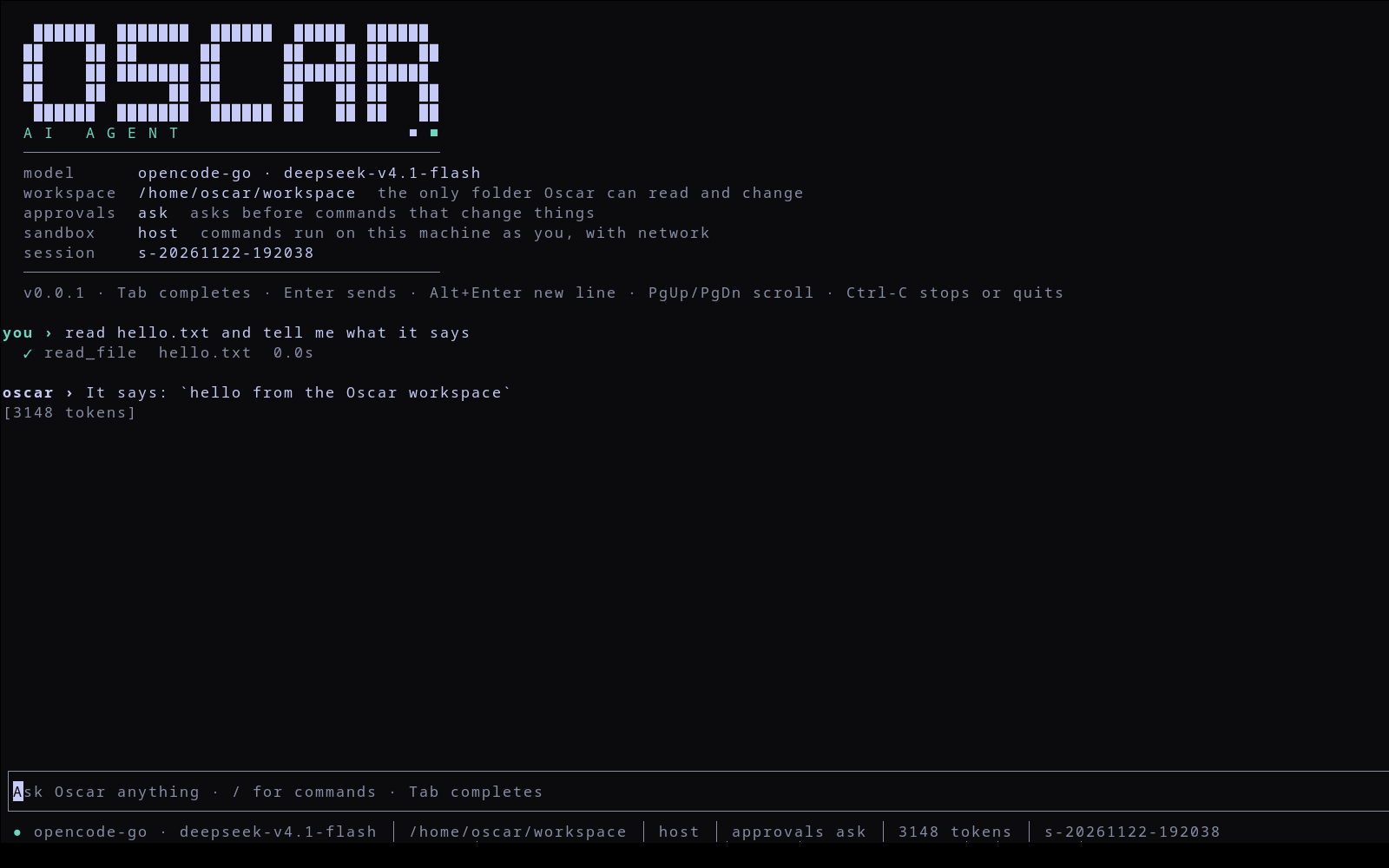
--lineThe provider is a choice, not a default. Oscar routes each OpenCode Go model to the API surface it actually speaks, and refuses a model it cannot run instead of silently downgrading it.
https://opencode.ai/zen/go/v1 OpenCode Go subscription. Chat, Anthropic-messages and Responses models routed per family.
https://openrouter.ai/api/v1 One key, a large catalogue. Oscar reads the live model list and checks tool support.
OPENAI_BASE_URL Any chat-completions endpoint: vLLM, LM Studio, a local gateway, a private proxy.
https://api.anthropic.com Native Messages API. Kept as an explicit choice, never assumed.
gpt- and grok- models), and a
request is never quietly sent somewhere else.Oscar joins Matrix as its own account. Invite it, allow your user, and talk to it from Element, Fractal, or anything else that speaks Matrix.
Encrypted rooms use Olm. Approval requests are bound to the message that asked; only an allowed user's reaction counts. A delivery ledger means a restart never answers the same event twice.
export MATRIX_HOMESERVER=https://matrix.example.org
export MATRIX_ACCESS_TOKEN=...
export MATRIX_ALLOWED_USERS=@you:example.org
export MATRIX_E2EE=on
oscar matrix serveMATRIX_E2EE_TRUST=any relaxes both, and says so.!new, !model, !undo, !retry, !status, !stop, !usage, !proposals, !accept.The approval list is a convenience. The operating system is the enforcement. Oscar is built so that a clever prompt cannot turn into an unbounded shell.
Every tool call passes one gate in one crate. allow, ask, deny and confirm are policy tiers, not a security
boundary. deny is final in every mode.
Shell tools run in a user + mount + pid + network namespace with a chroot, capability
drop and no_new_privs. A real escape attempt is in the test suite.
Every .git entry is bound read-only; newly created ones are quarantined.
The agent can read its own source but cannot rewrite the record of what happened.
Known secret shapes are replaced before model or tool text leaves the process. Control characters are escaped before anything is printed. Keys are never logged.
The loop and tools are Rust. Providers are adapters. State is SQLite and plain files. Lua is an extension point, not a second runtime to install.
The full architecture and every invariant live in the repository's design notes.
            ┌──────────────────────────────┐
  terminal  │  TUI / line chat / JSONL    │
  matrix    │  gateway + delivery ledger   │
            └──────────────┬───────────────┘
                           │
                  ┌────────▼────────┐
                  │   agent loop    │  prompt tiers · compression
                  └────────┬────────┘
                           │
             ┌─────────────▼─────────────┐
             │  approval gate → jail     │  deny · ask · confirm
             └─────────────┬─────────────┘
                           │
        ┌──────────────────┼──────────────────┐
        │                  │                  │
   files / shell        Lua tools        MCP / sources
        │                  │                  │
        └──────────────────┴──────────────────┘
                           │
                  ┌────────▼────────┐
                  │  SQLite + files │  sessions · memory · skills
└─────────────────┘Oscar is pre-release. This table is deliberately conservative: if it is not tested, it is not called done.
| Capability | State |
|---|---|
| Rust agent loop, tools, approvals | tested |
| OpenCode Go + OpenRouter routing, Responses API models | live |
| Host mode with audit; optional jail, .git binds, redaction | tested |
| SQLite sessions, memory, skills, curator, background reviews | working |
| Full-screen TUI + Matrix gateway | working |
| Web search, browser (CDP), MCP servers, Hindsight memory | working |
| Encrypted Matrix rooms (Olm) | verifying |
| Search across past conversations, subagents, code execution | in progress |
| Telegram and Discord | v1 |
| Voice, image input, scheduled jobs, credential vault | v1 |
oscar --version v0.0.1 · pre-release
Install it on a Linux box, point it at a model you trust, and read the code that runs between you and your machine.